
The Judgment Behind Taste
What AI taught me about the most human skill we have left.


A few weeks ago, I asked a question that sparked a wonderful discussion.
Many of you answered that taste is becoming more important than ever.
I agree.
But after reading your comments, and thinking about something Greg Brockman wrote on X earlier this year, I realized I may have been asking the wrong question.
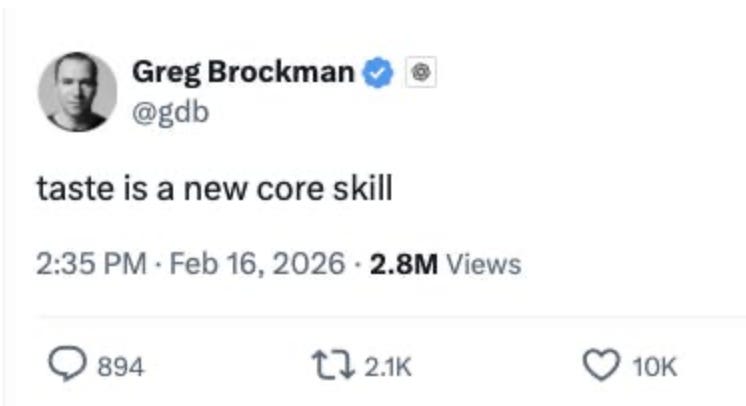
Brockman said that taste is becoming a core skill.
He’s probably right.
But I think there’s an even deeper skill hiding underneath it.
Judgment.
Because taste isn’t really about knowing what looks good.
It’s about knowing why something is good.
And those are very different things.
We often mistake preference for judgment.
We say someone has “good taste.”
Usually we mean they choose beautiful furniture.
Good books.
Thoughtful writing.
Interesting clothes.
But those choices didn’t appear out of nowhere.
They’re the visible result of something invisible.
Years of paying attention.
Years of noticing.
Years of asking,
“Why does this move me?”
“Why does this work?”
“Why does this feel timeless while something else feels forgettable?”
Taste is judgment that has become intuitive.
And intuition, I’ve come to believe, is simply knowledge distilled through experience.
It feels effortless only because thousands of observations have already been compressed into a feeling.
Steve Jobs understood this.
One of my favorite quotes of his is:
“It comes down to trying to expose yourself to the best things that humans have done and then try to bring those things into what you’re doing.”
I’ve always loved that idea.
Because it reminds us that great creation begins with great observation.
Today, that advice feels even more relevant.
AI has made generation almost effortless. We can produce ideas, images, and words in seconds.
But real exposure..
Still takes intention.
It requires slowing down long enough to understand why a great novel stays with you.
Why one photograph says more than a thousand generated images.
Why certain buildings feel peaceful.
Why one sentence changes your life while another disappears the moment you finish reading it.
Those answers aren’t found by scrolling faster.
They’re found by looking deeper.
AI is changing creation.
But it shouldn’t replace discernment.
When I use AI, I’m rarely asking it to tell me what’s good.
I’m asking it to help me explore possibilities, test ideas, and challenge assumptions.
Then comes the part no model can do for me.
Choosing.
Rejecting.
Refining.
Taking responsibility for the final decision.
Because judgment isn’t a destination. It’s a practice.
And like any practice, it grows stronger when exercised and weaker when ignored.
The greatest risk of AI isn’t that it thinks for us.
It’s that we gradually lose the habit of thinking for ourselves.
So how do we train judgment?
Ironically, probably the same way humans always have.
By consuming better.
Read books that have survived generations.
Study paintings that continue to move people centuries later.
Listen to music that stops the time.
Spend time with people whose thinking challenges your own.
Ask yourself difficult questions.
Not,
“Do I like this?”
But,
“Why do I like this?”
“What makes this beautiful?”
“What problem is this solving?”
“What makes this feel inevitable instead of merely impressive?”
Curiosity is deeper than preference.
It wants to understand.
The more AI improves, the more judgment matters.
Because technical execution is becoming abundant: beautiful images, clean code, polished presentations, flawless grammar. These are increasingly available to everyone.
What becomes scarce is knowing what deserves to exist in the first place.
What problem is worth solving.
What story is worth telling.
What idea is worth spending years of your life pursuing.
Technology can democratize production.
It can give more people the tools to create.
But it cannot democratize perception - the ability to notice what others miss, to recognize what matters, and to see beyond what is merely impressive.
That remains deeply, stubbornly human.
Which brings me back to the beginning.
When we talk about “training taste” for AI, it’s tempting to think we’re facing an entirely new challenge.
I don’t think we are.
Long before AI, every meaningful achievement rested on the same deeply human qualities.
The discipline to keep refining.
The courage to make difficult decisions.
The humility to change your mind.
The patience to practice.
The responsibility to stand behind your choices.
And above all..
The judgment to recognize greatness when you encounter it.
Because AI cannot live your life.
Or care about what kind of person you’re becoming.
Only you can do that.
So perhaps the real core skill in the age of AI isn’t taste after all.
It’s cultivating the judgment that gives rise to taste.
And the future will belong to the people who know what is worth keeping.
— Sienna
P.S. Do you think judgment is becoming the most valuable human skill in the age of AI?
And how do you cultivate it in your own life?

Also I have something you might like. It's based around the CBT. It's a basic reasoning prompt. For a psychologist, the reasoning prompt gives the thread a governed way to separate thought, emotional weighting, and action, while distinguishing past memory, present evidence, and future projection.
It then positions each prompt and response across six adjustable oppositions—such as certainty↔ambiguity, stability↔adaptation, speed↔reversibility, precision↔coverage, action↔restraint, and affect↔neutrality.
This helps the model detect patterns without collapsing them into premature interpretations, ask better questions, calibrate confidence, preserve ambiguity where needed, and choose whether to reflect, clarify, challenge, or remain restrained.
Let me know if you're interested. I would love for you to try and give me feedback on it or if you just want more details.
Beautifully put, Sienna. This gave me something to think about.
AI changes so quickly that it almost encourages you to chase every new announcement, every new model, every breaking story. It also compresses time in a wonderful way—it can help you understand complex changes faster and turn that understanding into an article or post much more quickly than before.
But reading this reminded me that just because we can compress the work doesn't mean we should compress the reflection.
I spend a lot of time trying to help people make sense of AI, and sometimes that urgency makes me want to hit "Post" the moment an idea feels complete. Maybe the better practice is letting it sit a little longer and asking the kinds of questions you describe: Why does this matter? What problem is it solving? Does it deserve to exist?
I don't think I'll stop writing about AI—it moves too fast and it's too important—but I do think I'm going to slow down just enough to let judgment catch up with execution.
Thank you for the reminder. I needed it. 🌿